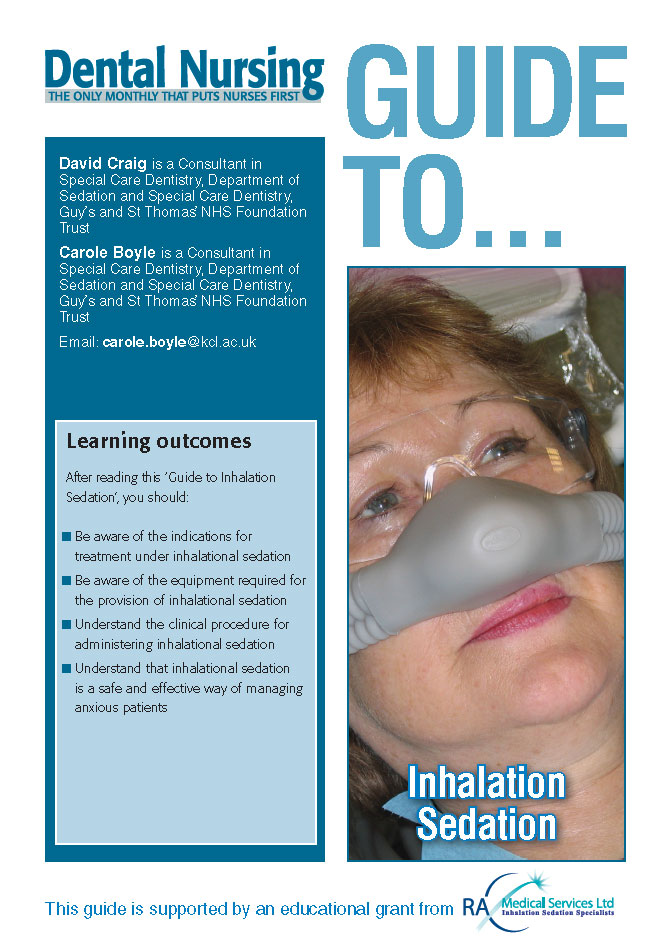
Inhalation sedation using nitrous oxide and oxygen is one of the most widely used conscious-sedation techniques in UK dentistry. This guide covers the clinical procedure: pre-use checks of the machine, titration of the gas mix, monitoring during treatment, and recovery. It is intended as a practical reference for the whole dental team.
What you'll learn
- Perform a pre-use check of an inhalation sedation machine.
- Titrate nitrous oxide and oxygen safely for the individual patient.
- Monitor the patient during treatment and identify the signs of over-sedation.
- Manage recovery and discharge the patient safely.
Many patients find dental treatment stressful. Reactions range from 'normal' fear, through various degrees of anxiety to phobia. The Adult Dental Health Survey 2009 found that 36% of adults had moderate dental anxiety and 12% had extreme dental anxiety. The two items most feared are having a tooth drilled and receiving local anaesthesia.
Inhalational sedation (IS) with nitrous oxide and oxygen is a safe technique and, combined with effective local anaesthesia, will allow anxious patients to accept dental care. It is particularly suitable for children, slightly or moderately anxious adults and gagging patients. Non-anxious patients may also benefit if the proposed procedure is potentially unpleasant or prolonged.
Conditions that may contraindicate inhalational sedation include nasal obstruction, poor cooperation, and fear of masks. IS should not be used during the first three months of pregnancy.
A satisfactory first visit is crucial to the success of subsequent treatment under conscious sedation. There is a great deal of information to acquire from the patient, but at the same time, the patient is also assessing the dental team. The first meeting should ideally be outside the surgery environment and in the nature of an informal 'chat'.
Nitrous oxide is a colourless and virtually odourless anaesthetic gas. It has a low blood/gas solubility and a high minimum alveolar concentration (MAC). The low solubility means induction and recovery are rapid. The high MAC means it is not very potent — which is exactly what makes it a very safe gas for dental sedation.
Nitrous oxide has very few cardiovascular or respiratory effects. It is rapidly excreted via the lungs after discontinuing administration. It has excellent anxiolytic, sedative and analgesic properties and a wide margin of safety.
Advantages of inhalational sedation include:
- No 'needles'
- Level of sedation easily altered
- Minimal impairment of reflexes
- Rapid induction and recovery
- Some analgesia
- An escort is not mandatory for fit adult patients
Disadvantages include:
- Sedation depends on good psychological support
- Mask may make oral access difficult
- Postoperative amnesia variable
- Nitrous oxide pollution to the surgery atmosphere (must be scavenged).
Because of the relatively poor solubility of nitrous oxide, there is rapid outflow across the alveolar membrane when the gas is turned off. This can dilute the percentage of alveolar oxygen by up to 50% — a phenomenon called diffusion hypoxia. It is prevented by giving 100% oxygen for at least two minutes at the end of the procedure.
Modern inhalation sedation machines are specially designed to safely deliver nitrous oxide and oxygen sedation. Nitrous oxide is supplied in a blue cylinder (containing both gas and liquid phase); oxygen comes as compressed gas in a black cylinder with a white collar. Most portable machines are designed to operate with two nitrous oxide and two oxygen cylinders — one of each gas is 'in use', the other held in reserve.
A Pin Index Safety System ensures that nitrous oxide and oxygen cylinders cannot be accidentally interchanged. Pressure gauges indicate cylinder contents, but note that the nitrous oxide gauge only starts to fall when the liquid phase is exhausted.
The popular MDM RA machine 'head' has flowmeters for nitrous oxide and oxygen, a control valve for regulating total gas flow, and a mixture dial for adjusting the percentage of each gas. All modern machines are incapable of delivering less than 30% oxygen and have a failsafe that shuts off nitrous oxide if oxygen flow ceases.
The mixed gases emerge at the common gas outlet to which the breathing system is connected. The reservoir bag is useful for adjusting total gas flow to the patient's minute volume and for monitoring respiration during treatment.
Scavenging of waste gases should be active, with an airflow rate of 45 L/min at the nasal mask. Modern scavenger systems vary slightly in tubing and mask arrangements but all require connection to an exhaust. This enables the optimum flow rate proven to reduce ambient surgery pollution and comply with the 100 ppm time-weighted average.
Fit of the nasal mask is vital. Double masks offer a better anatomical profile than single masks, but both types are widely available in autoclavable or disposable options.


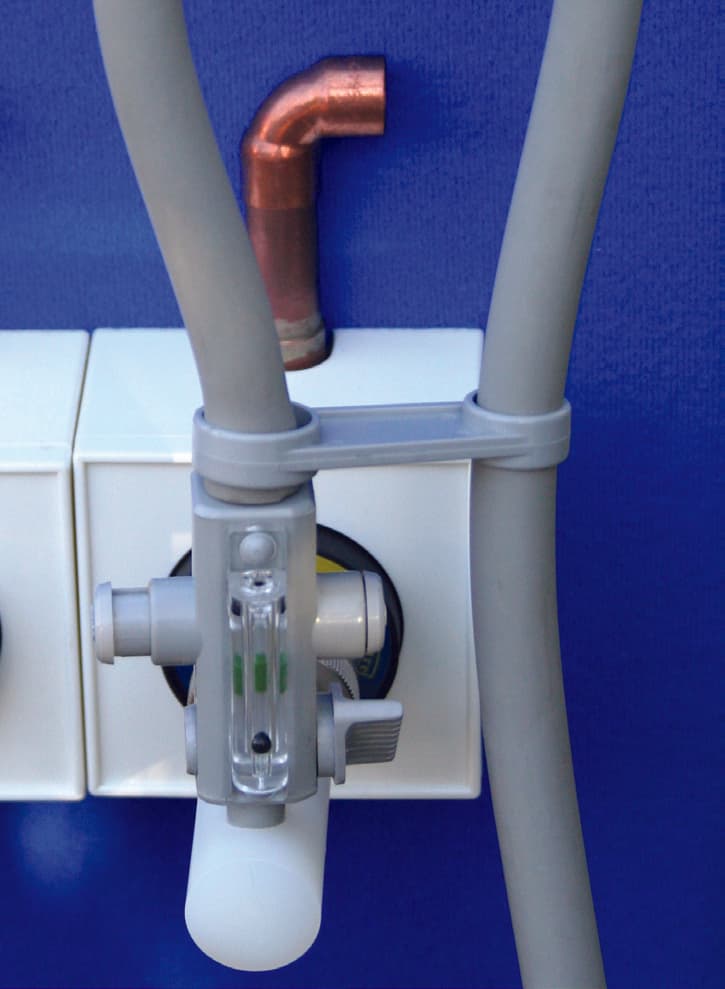
Before every sedation procedure, perform the following MDM pre-use check sequence:
- Turn all cylinders off.
- Turn on the 'in use' oxygen cylinder.
- Set the mixture control to 100% oxygen and adjust the flow control to 6 L/min.
- Check the nitrous oxide flowmeter is reading zero.
- Turn on the 'in use' nitrous oxide cylinder.
- Change the mixture to 50% oxygen.
- Check that both flowmeters show 3 L/min.
- Cover the common gas outlet with the palm of your hand and press the oxygen flush.
- Ensure the reservoir bag inflates and that there are no leaks (neck and seams).
- Turn off the 'in use' oxygen cylinder.
This sequence confirms the machine is delivering the correct gas mix and that there are no leaks in the breathing system. Document the check on your pre-use checklist.
A detailed pre-use checklist is available from R A Medical on request, suitable for C3000 MXR, MDM, Digital Ultra, Ultra PC, Accutron Newport, McKesson and Porter Brown systems.

Having checked the machine and confirmed cylinders / piped gases are available and the breathing system is intact, the patient is laid supine in the chair and the procedure explained.
The machine is adjusted to administer 100% oxygen at a flow rate of 6 L/min, and the correct size nasal mask is selected. Maintain a steady flow of conversation and encouragement. The oxygen flow rate (minute volume) may be checked by observing the movement of the reservoir bag — under- or over-inflation means the gas flow needs to be adjusted.
Ten percent nitrous oxide is then added (90% oxygen) and the patient informed that they may feel light-headed, changes in visual or auditory sensation, tingling of hands and feet, spreading warmth, or a sense of being remote from the immediate environment. This concentration is maintained for one full minute, with plentiful verbal reassurance.
The concentration of nitrous oxide is increased by 10% for a further full minute (to 20% N₂O total) and then in increments of 5% until the patient appears and feels sufficiently relaxed. Nitrous oxide concentrations of 20–50% commonly allow a state of detached sedation and analgesia without loss of consciousness or obtunded laryngeal reflexes — patients remain aware of the procedure and co-operative without being fearful.
If the patient becomes restless or apprehensive after a period of relaxation, the concentration of nitrous oxide is probably too high. Titration to effect is the rule.
At the end of the procedure:
- Stop the nitrous oxide flow and continue with 100% oxygen for at least 3–5 minutes — this prevents diffusion hypoxia.
- Confirm the patient is alert, responsive, and able to walk unaided.
- Check that the patient can give their name, date of birth and current location.
- Provide postoperative instructions — both verbal and written.
- Confirm the patient has a responsible adult to accompany them home and to stay with them for the rest of the day.
- Document the procedure in the clinical notes.
Most patients recover within 5–10 minutes of stopping the nitrous oxide. The patient should not drive, operate machinery, or make important decisions for the rest of the day. Recovery is usually complete within 15–30 minutes overall.
Key takeaways
- Always titrate to effect. Start at 100% oxygen and introduce nitrous oxide in 10% increments.
- Never drop oxygen below 30%. Most flowmeters have a built-in safeguard — confirm it on your specific machine.
- Continue 100% oxygen for 3–5 minutes at the end of the procedure, and only discharge when the patient is alert, mobile and accompanied.
References
- Society for the Advancement of Anaesthesia in Dentistry (2000). Standards in Conscious Sedation for Dentistry. SAAD, London.
- Department of Health (2003). A Conscious Decision. DH, London.
- General Dental Council. Scope of practice.
Originally developed as a sponsored educational supplement in Dental Nursing magazine. Re-published by R A Medical Services Ltd with all third-party branding removed.