
Any patient can have a medical emergency during dental treatment. Of course, everyone hopes it will never happen to them — but what if it does? Would you be prepared and able to cope — and are your drugs and equipment in date and ready for use? This guide sets out the drugs and equipment the Resuscitation Council UK recommends a general dental practice should hold, how to store them, and how to keep them ready. The original content was published on the R A Medical website in 2012 and has been re-published here with updated references and the current Resuscitation Council UK guidance.
What you'll learn
- Identify the drugs a dental practice should hold for medical emergencies.
- Specify the equipment that should accompany the emergency drug kit.
- Choose the right size of portable oxygen cylinder and the right regulator type.
- Understand the Resuscitation Council UK position on automated external defibrillators (AEDs) in dental practice.
- Set up a system for regular inspection and replacement of emergency equipment.
The Resuscitation Council UK publishes a list of recommended emergency equipment for primary dental care. The drug list is the starting point. The kit should contain:
- Glyceryl trinitrate (GTN) spray (400 micrograms / dose) — for acute angina.
- Salbutamol aerosol inhaler (100 micrograms / actuation) — for acute asthma.
- Adrenaline injection (1:1000, 1 mg/ml) — for anaphylaxis.
- Aspirin dispersible (300 mg) — for suspected myocardial infarction.
- Glucagon injection (1 mg) — for hypoglycaemia.
- Oral glucose solution, tablets, gel or powder — for hypoglycaemia.
- Midazolam (5 mg/ml or 10 mg/ml, buccal or intranasal) — for seizures.
- Oxygen — discussed separately below.
With the exception of the oxygen, these drugs should be stored together in a secure, purpose-made storage box, identified as such. Care should be taken to ensure that all drugs are kept within their ‘use by’ dating. The kit should be checked at least monthly, with a documented record of the check.
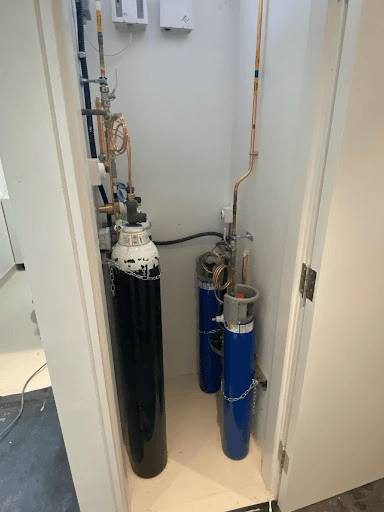
Oxygen cylinders for emergency use should be portable, so they can be used in any part of the building. There is some debate about the right cylinder size:
- CD size — 340 gaseous litres. Sometimes seen as adequate.
- E size — 680 gaseous litres. More commonly recommended; gives greater margin in a sustained emergency.
The minimum flow rate to plan for is 10 L/min for 30 minutes — 300 gaseous litres. An E-size cylinder provides more than double this, with a useful safety margin. The downside is that an E-size cylinder is heavy and will require a cylinder trolley. Various trolleys are available — they differ mainly in cost and minor construction details.
The single most important practical point: make sure there is enough gas. The oxygen must not run out during an emergency. Both CD and E sizes require a pressure-reducing regulator with a pin-index fitting.
Regulator choice
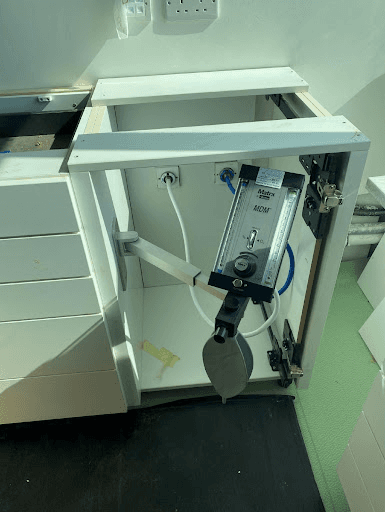
In an emergency, a robust dialreg-type regulator is preferable. It allows the user to dial the percentage of flow rather than using a rotometer with a flow knob. Rotometers can be prone to accidental damage and leakage. The MHRA bulletin MDA/2003/016 — Medical gas regulators and flowmeters sets out a system for the regular inspection and replacement of gas regulators, in line with the manufacturer’s instructions. The recommended replacement interval varies from four to five years, depending on the manufacturer.
A spare cylinder should be kept, and the equipment checked on a regular basis to ensure it is ready for use at all times. If spare cylinders are kept, the storage area should be identified with a compressed gases sign.
The minimum equipment list that should accompany the emergency drug kit:
- Oxygen face mask and tubing.
- Basic set of oropharyngeal airways (sizes 1, 2, 3 and 4).
- Pocket mask with oxygen port.
- Self-inflating bag and mask apparatus with oxygen reservoir and tubing (staff should be appropriately trained to use this).
- A variety of well-fitting adult and child facemasks for attaching to the self-inflating bag.
- Portable suction with appropriate suction catheters and tubing — e.g. Yankauer suction tubes, adult and child.
- Single-use sterile syringes and needles.
- A ‘spacer’ device for inhaled bronchodilators.
- An automated blood-glucose measurement device.
- A non-invasive blood pressure monitor / pulse oximeter.
- An automated external defibrillator (AED) — discussed below.
With the exception of the last two items, the above are relatively inexpensive. Components such as the oxygen face mask / tubing, airways, pocket mask and self-inflating bag are designated as single-patient-use items and come with a useful shelf life. All items should be latex-free.
The AED is the most expensive item on the emergency equipment list, and the requirement to have one in a dental practice has historically been a matter of some debate. The current position is clear.
In July 1999, the Department of Health issued the white paper Saving Lives: Our Healthier Nation, with an initial investment of £1 million in installing AEDs in busy public places. A further £1 million was committed to training in AED use and basic life support. AEDs were installed in railway stations, airports, coach stations and ferry ports — approximately 110 locations initially, with more than 6,000 volunteers trained in AED and basic life support skills. The criterion for installation was that an incident could be responded to within two minutes. This initiative is now widening to include public places such as shopping centres and theatres.
The Resuscitation Council UK, in Medical Emergencies and Resuscitation (most recently revised in 2021), state that “it is an expectation of the public that AEDs should be available in every healthcare environment, and the dental surgery is not seen as an exception.”
The practical upshot: a dental surgery should have an AED, and the team should be trained in its use. The cost of an AED has fallen significantly in the last decade, and the cost of a missed opportunity in a cardiac emergency is high. A modern AED will guide the operator through the process with voice prompts and is straightforward to use with a half-day of training.
An emergency kit is only as good as its last check. The Resuscitation Council UK recommends a documented system of regular checks. The minimum practical schedule is:
- Weekly — visual check that the kit is in its expected location, complete, and that the oxygen cylinder contents gauge shows adequate pressure. Replace anything used.
- Monthly — full check of the drug kit, with all expiry dates recorded. Order replacements at least three months before expiry.
- Quarterly — full check of the equipment list, including the AED (battery, pads, indicators). Document the check.
- Annually — full audit of the kit, including regulator replacement cycle, AED pad replacement (typically every 2–4 years depending on the model), and any manufacturer updates. Replace the battery on the AED if due.
The single most common failure mode in practice drills is the missing or expired item. A 30-second weekly check, signed by the duty nurse, eliminates the vast majority of these failures.
Key takeaways
- The Resuscitation Council UK list is the right starting point: eight drugs plus oxygen, plus an equipment list including an AED.
- Choose an E-size oxygen cylinder for the safety margin. Use a dialreg regulator. Have a spare cylinder and a documented check schedule.
- An AED is expected. The Resuscitation Council UK position is that a dental surgery is not exempt from the public expectation that an AED is available.
- A documented weekly visual check, monthly drug check, and quarterly equipment check is the minimum practical schedule. The most common failure is the missing or expired item.
- A regular audit of the kit — and a practice drill at least once a year — is the difference between a kit that is on the shelf and a kit that works when it is needed.
References
- Resuscitation Council UK. Medical Emergencies and Resuscitation in Dental Practice. (Current revision, most recently 2021.)
- Resuscitation Council UK. Quality Standards for CPR Practice and Training.
- Department of Health (1999). Saving Lives: Our Healthier Nation. DH, London.
- MHRA. MDA/2003/016 — Medical gas regulators and flowmeters.
- British National Formulary (BNF). Current edition. Section on emergency treatment of medical emergencies.
Originally published on the R A Medical website in 2012. Converted to a guide format for the R A Medical website and updated for the 2026 catalogue with the current Resuscitation Council UK guidance.


