
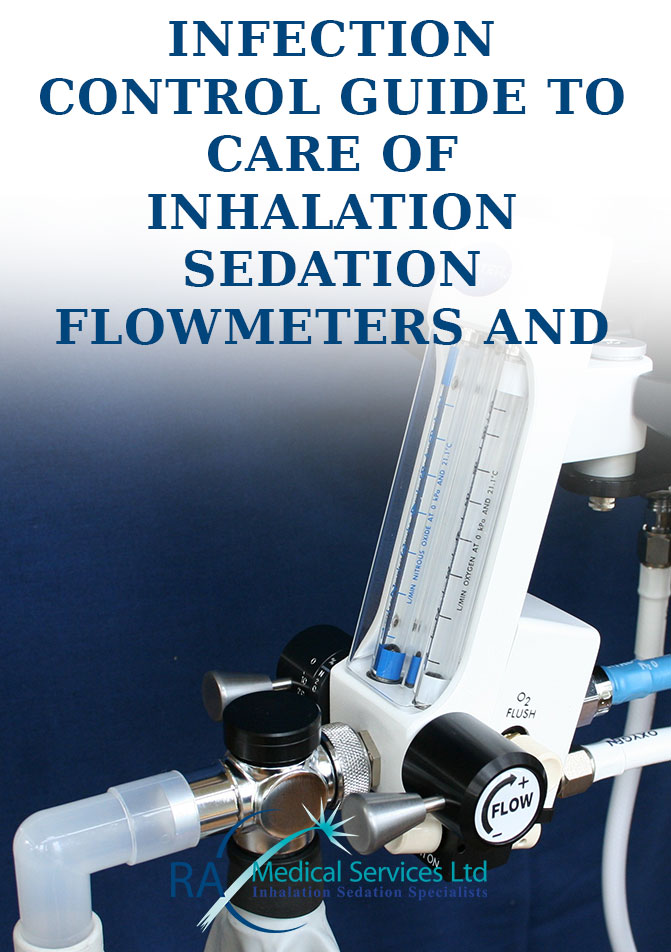
Infection control procedures for inhalation sedation equipment are frequently misunderstood — both by practices that are over-cautious and by practices that are under-cautious. The risks are different from those of routine dental handpieces, and the manufacturer’s protocol is the right starting point. This guide sets out the protocol R A Medical has issued since 2009, covering the flowmeter types currently in service in the UK and the three main brands of scavenger breathing system. It complements the practice-authored Cross-Infection Control guide, which covers the wider decontamination workflow.
What you'll learn
- Identify the flowmeter types currently in production in the UK and Ireland.
- Apply the correct external-cleaning protocol for the flowmeter in your practice.
- Decontaminate a Porter Brown, Accutron or Matrx ANS breathing system to the manufacturer’s specification.
- Understand why bacterial filters are not required for use with a dedicated sedation flowmeter.
- Decide when to use disposable breathing components and when to reprocess reusable ones.
The equipment used for relative-analgesia sedation has its own decontamination quirks. The breathing system sits in the patient’s mouth and nose. The fresh gas hose carries the titrated gas mix to the nasal hood. The mixing head is touched by the operator during every procedure. The decontamination of all three follows a different logic from the rest of the dental surgery.
The good news is that the equipment is engineered with infection control in mind. Dedicated sedation flowmeters have one-way valving on the fresh gas outlets that prevents the patient’s exhaled breath from contaminating the inside of the unit or the reservoir bag. In a unit that is correctly maintained, this valving is preserved — and the inside of the flowmeter and bag is never exposed to human breath. That is why bacterial filters, as used in general-anaesthetic circuits, are not necessary and not recommended for use with a dedicated sedation machine.
The cleaning and sterilisation work is on the outside of the flowmeter body and on the breathing system that connects the flowmeter to the patient. The protocol below covers both, for the flowmeters and breathing systems in current UK service.
The flowmeter types you will find in UK and Irish practices fall into three groups.
Analogue flowmeters:
- Cyprane or Matrx Analogue MDM (often referred to as Quantiflex).
- Quantiflex Mark II (Cyprane, Fraser Sweatman).
- McKesson 882 / 883 and Mc1.
Digital flowmeters (newer generation, designed with infection control in mind):
- Matrx Digital MDM.
- Porter C2000 and C3000 MXR.
Digital flowmeters (Accutron range):
- Ultra and Newport.
Of these, the MDM, DMDM and C3000 MXR are now all manufactured by Porter Instruments (USA). The Mc1 is manufactured by McKesson / Cestradent (UK). The Ultra and Newport are manufactured by Accutron (USA). The Quantiflex Mark I and Mark II are no longer in production but remain in service in older practices.


External cleaning of the flowmeter
The Matrx MDM and DMDM can be wiped over externally using a germicide containing glutaraldehyde, following the manufacturer’s directions for use. Take care with the DMDM touch-screen face — a disposable barrier shield is a useful alternative.
For the C3000 MXR, the manufacturer’s recommendation is an approved disinfectant for the dental environment, again following the disinfectant manufacturer’s directions and cautions. The same approach applies to the Mc1, Ultra, Newport and Quantiflex Mark II.
Clinical E-cloths can be used to remove surface dirt and contamination. They should be colour-coded, damp (not wet), and used by gently wiping over the flowmeter and the associated mounting — for example, a mobile 4-cylinder stand. Never spray directly onto the flowmeter. Excess fluid will cause damage. If using an E-cloth, dip it in warm water and wring out thoroughly before applying. For the wider background on this approach, see the Revised Healthcare Cleaning Manual (NPSA) and the Department of Health’s An Integrated Approach to Hospital Cleaning: microfibre cloth and steam cleaning technology.
> Important: flowmeters must never be immersed in liquid. If this happens, quarantine the unit and contact the service provider.
Reservoir bags
Reservoir bags are usually made of grey non-latex material. They are protected from internal contamination by the non-return valving of the flowmeter outlet. If required, they can be externally cleaned with a mild detergent such as tri-sodium phosphate or a neutral liquid soap. They can also be autoclaved, provided the maximum temperature does not exceed 137°C — lower sterilisation temperatures extend product life. It is not necessary to change the reservoir bag between patients, and disposable reservoir bags (typically green) are not required.
The three most frequently seen brands of scavenger breathing system on the UK marketplace are the Porter Brown, the Accutron and the Matrx ANS (Autoclavable Nitrous Scavenger). Each has its own manufacturer protocol.
Porter Brown double-mask system
The Porter Instruments protocol is to place the following items in an ultrasonic with water and an enzymatic instrument cleaner, manually clean (if necessary) with soap and water, and sterilise in a steam autoclave on a low-temperature cycle (121°C is recommended):
- Porter Adult Hood (grey) — 5054A
- Porter Adult Liner (grey) — 5054-1
- Porter Paediatric Hood (grey) — 5054B
- Porter Paediatric Liner (grey) — 5054-2
- Fresh Gas Y Connector (grey) — 5058
- Vacuum Line Y Connector (grey) — 5062
- Tension Slide Adjuster (grey) — 5057
- Mask to Tubing Connectors — pair (grey) — 5061
- Vacuum Hose (grey) — 5059
- Fresh Gas Hose (cream autoclavable only) — RA2011, rinsed with soap and water and autoclaved
The Vacuum Control Block 5501-RK and Vacuum Tube Holder 5056 are wiped down with a disinfectant-type wipe. Do not autoclave or immerse in liquid.
The 121°C cycle requires a longer cycle time than the 134°C cycle, but provides the same assurance of sterilisation and is gentler on the components — extending product life.
> Warning — chemical disinfectants. These are not recommended for the Porter Brown system. Disinfectants do not provide the same reduction in microbial contamination as sterilisation, and they can leave a residue on the mask and liner that may irritate or even chemically burn the patient’s skin or mucous membranes if not rinsed thoroughly.
Accutron scavenger system
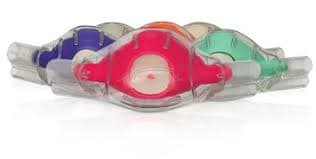
The Accutron system is similar in appearance to the Porter Brown, except the tubing is white rather than grey. The vacuum control block is placed in-line with the vacuum hose, and the system uses autoclavable or scented single-patient-use nasal hoods with a clear collector cap, or a double mask such as the Clearview.
For the reusable components, the manufacturer’s instructions are:
- The components must be thoroughly cleaned before reuse.
- The spiral vacuum tubing containing the vacuum flow gauge is not autoclavable and must not be submerged in liquid solutions.
- Single-use PIP+ or Clearview nasal hoods must not be reprocessed.
Matrx ANS (Autoclavable Nitrous Scavenger)
The Matrx ANS manual states that most ANS components are autoclavable. Matrx recommends following the specific protocol of the service or the steriliser manufacturer. Temperatures consistent with silicone, Ultem (polyetherimide) and polysulfone, in the range of 120°C to 134°C, can be used.
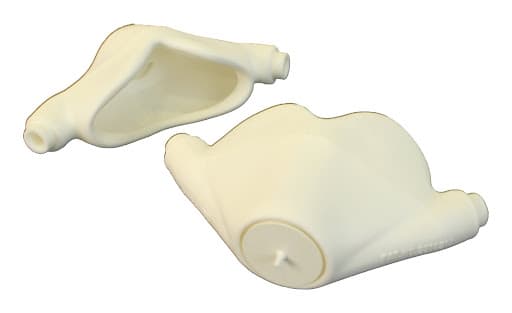
The system should be disassembled, with each tube and the scavenging cone washed with a mild alkali detergent, and all parts (except those specifically precluded) autoclaved. Precluded parts are: white single-use nasal hoods and the scavenger control valve. The system can be used with blue autoclavable nasal hoods and white Dynomite single-patient-use nasal hoods. ANS components are latex free.
On the obsolete Matrx Passive system
The Matrx Passive system was on the marketplace for over 40 years, originally designed to scavenge ‘passively’ — i.e. an air flow rate at the nasal mask of no more than 0.5 L/min, even when connected to an AGSS with an air break in-line. It had infection control issues: only the blue nasal hood could be autoclaved. Porter Instruments discontinued production in September 2009. The system type is now considered obsolete for dental application.
HTM 01-05 (Decontamination in primary care dental practices) does not specifically mention R A Medical or inhalation sedation equipment. However, the audit tool Assessing Implementation of HTM 01-05 does. Section 5 — Management of Dental Medical Devices — has a sub-heading for Inhalation Sedation Machines (ISM) and includes the following questions:
- Are IS flowmeters used and maintained in accordance with OEM (Original Equipment Manufacturer) or supplier’s instructions?
- Are IS breathing systems (masks and tubing) used in accordance with manufacturer’s or supplier’s instructions (also refer to Q14)?
Q14 is the catch-all question on single-use items: “Are single-use items only used for single treatment episode and disposed of following use?”
In practice, the audit assessor will want to see:
- Documented evidence of the manufacturer’s protocol for the specific flowmeter and breathing system in your practice.
- A record of reprocessing cycles — dates, parameters, operator.
- A pre-use checklist for each session (most practices use a laminated quick-reference card signed by the dental nurse at the start and end of each session).
- Evidence that staff have read and signed the relevant sections of the manufacturer’s instructions for use.
The protocol in this guide, applied to the specific equipment in your practice, will satisfy all four of the above.
Most breathing systems are designed to be autoclaved, but with the option of using disposable, single-patient-use components. The range runs from nasal hoods and inner liners (for use with autoclavable double masks) to coaxial hoses.
From 2012, a fully disposable End Change Set became available from R A Medical. The set comprises: a pair of green coaxial hoses, a clear slide adjuster, clear hood/hose connectors, and a Clearview double mask. These components are designed to be combined with the Porter Brown vacuum hose and vacuum control block, the Vacuum Y connector, the Fresh Gas Y connector and the fresh gas hose — completing the breathing system circuit. The practical upshot: every part of the breathing system that comes into contact with the patient can be changed and disposed of following use.
The End Change Set is particularly useful for:
- Practices with a high patient turnover and limited autoclave capacity.
- Treating patients with a known or suspected infection where the single-use route is preferred.
- Practices with mixed equipment where full compatibility with disposable single-use components is helpful.
For most practices, the autoclave route remains the most cost-effective and is what the manufacturer’s protocol assumes. The disposable route is a complement, not a replacement, and is best used selectively.


Key takeaways
- A dedicated inhalation sedation flowmeter has one-way valving that prevents patient breath from contaminating the inside of the unit. Bacterial filters are not required.
- Wipe the flowmeter body with a damp (not wet) cloth. Never spray directly onto the equipment. Never immerse in liquid.
- Autoclave the breathing system components to the manufacturer’s protocol. Porter Brown: 121°C. Accutron: do not autoclave the spiral vacuum tubing. Matrx ANS: 120–134°C per the manual.
- Keep a documented pre-use checklist and a record of every reprocessing cycle. This is what HTM 01-05 auditors will ask to see.
- The disposable End Change Set is a useful complement, not a replacement, for the autoclave protocol. Use it where it adds value — high turnover, infectious patients, mixed equipment.
References
- Department of Health (2003). A Conscious Decision: A review of the use of general anaesthesia and conscious sedation in primary dental care. DH, London.
- Department of Health (2013). HTM 01-05: Decontamination in primary care dental practices. DH, London.
- Infection Prevention Society (2009). Local Self-Assessment Audit for Assessing Implementation of HTM 01-05.
- National Patient Safety Agency. The Revised Healthcare Cleaning Manual.
- R A Medical Services. Manufacturer decontamination protocols for Porter Brown, Accutron and Matrx ANS breathing systems. Internal reference RAM/IC/417/003.
Originally issued by R A Medical Services as RAM/IC/417/003 (Issue 3, 2015). Converted to a guide format for the R A Medical website.


