Inhalation sedation is one of the safest forms of conscious sedation. But the safety is conditional — chronic exposure to nitrous oxide poses a potential health risk to dental personnel. This guide looks at the HSE exposure limits, the practical steps to minimise ambient nitrous oxide levels, and the monitoring programme that keeps your team safe.
What you'll learn
- Understand the HSE workplace exposure limit for nitrous oxide.
- Identify the practical steps that minimise ambient nitrous oxide levels in the surgery.
- Choose a monitoring programme that demonstrates compliance.
- Know what to do in the event of a known overexposure.
The HSE workplace exposure limit (WEL) for nitrous oxide is 100 ppm over an 8-hour time-weighted average.
This is straightforwardly achievable with:
- A well-fitted nasal mask (Porter Brown Double Mask is the gold standard).
- An active scavenging system at 45 L/min.
- Good room ventilation — 12–15 air changes per hour, or a low-level extract fan.
- Sensible working practices — talking to the patient during the procedure (mouth-breathing increases leak), keeping the mask in place, switching off the nitrous oxide as soon as practical.
A 1998 paper in the British Dental Journal (Blain and Hill) found that with appropriate measures, average ambient N2O levels in a dental surgery could be kept well below 100 ppm.
The biggest single source of ambient nitrous oxide is the patient's mouth. The biggest single fix is a good mask fit. Beyond that:
- Use a Porter Brown Double Mask (or equivalent double-mask design). Single-mask designs leak significantly more, particularly during talking or mouth-breathing.
- Run the active scavenging at 45 L/min. Verify the flow rate annually as part of the equipment service.
- Switch off the nitrous oxide during the procedure if you are not actively titrating. Some clinicians deliver 100% O2 between titrations, which both reduces leak and speeds recovery.
- Talk to the patient about nasal breathing. Mouth-breathing is the single biggest cause of high ambient levels.
- Avoid lengthy procedures under sedation. If a procedure is going to take more than 60 minutes, consider breaking it into two appointments.
- Provide good surgery ventilation. 12–15 air changes per hour is the standard. If the surgery has no mechanical ventilation, a low-level extract fan is a low-cost improvement.


Two practical options:
- Diffusion pen — worn on the clinician's lapel for the duration of a sedation session, then sent to a lab for analysis. The lab returns a TWA reading for the session. Suitable for annual or biannual checks.
- Gas analyser (e.g. Geotech G200) — a portable instrument that records ambient levels in real time, with results on screen. More expensive, but useful when commissioning a new surgery or following changes to the scavenging setup.
For most practices, an annual diffusion pen check is sufficient to demonstrate compliance. Keep the results in your health and safety file.


If monitoring shows an exposure above 100 ppm:
- Investigate the cause — usually a mask-fit issue, a scavenging fault, or both.
- Rectify the cause. Get the scavenging system serviced. Replace the nasal mask. Re-train the team.
- Re-test after the rectification.
- Document the incident, the investigation, the rectification, and the re-test.
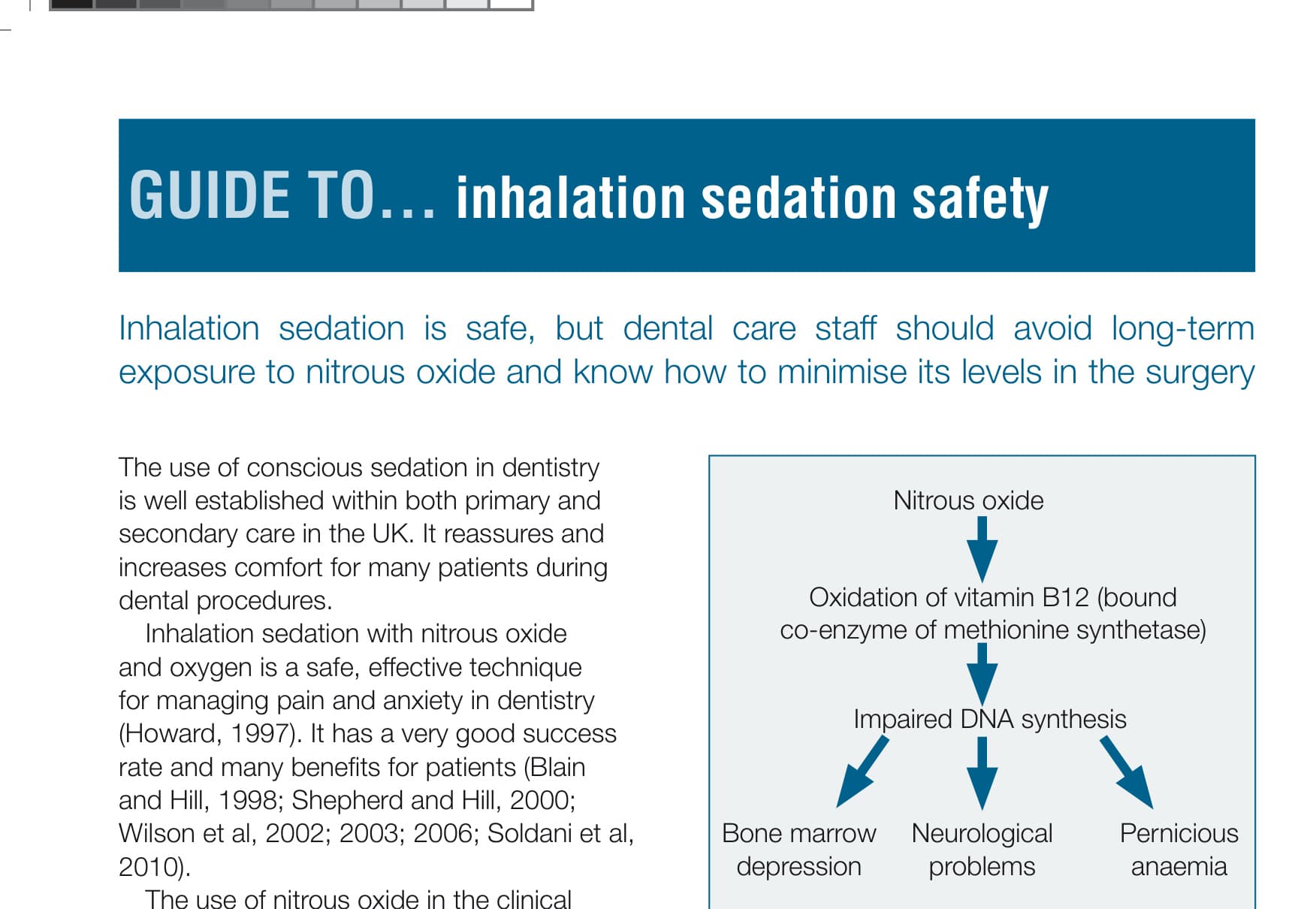
For chronic overexposure (over a long period, typically in a poorly-managed surgery), the documented health effects include:
- Vitamin B12 inactivation (leading to megaloblastic anaemia and neurological symptoms in severe cases).
- Reduced fertility in female dental staff exposed to high ambient levels.
- Spontaneous abortion rates elevated in staff exposed to unscavenged nitrous oxide (the historical evidence is from unscavenged practices; with adequate scavenging, the rate is not elevated).
These effects are not seen in staff working in scavenged surgeries. The combination of good equipment, good technique, and a monitoring programme is highly effective protection.

Key takeaways
- The HSE limit is 100 ppm over 8 hours. With good equipment and technique, this is straightforward to achieve.
- The Porter Brown Double Mask is the single biggest improvement you can make — the fit dramatically reduces leak.
- Annual diffusion-pen monitoring is a low-cost way to demonstrate compliance.
References
- Health and Safety Executive. Workplace exposure limits: EH40.
- Blain KM, Hill FJ (1998). The use of inhalation sedation and local anaesthesia as an alternative to general anaesthesia for dental extractions in children. Br Dent J 184(12): 608–11.
- Department of Health (2006). Medical Gas Pipeline Systems. HTM 02-01. DH, London.
Originally developed as a sponsored educational supplement in Dental Nursing magazine. Re-published by R A Medical Services Ltd with all third-party branding removed.


